
WHAT YOU NEED TO KNOW
- Saudi authorities issued aerial attack alerts before Reuters reported booms, smoke and flames near King Khalid International Airport.
- Pakistan urged Iran to support uninterrupted energy supplies and safe, rapid passage for ships.
- Brent has risen 72% since the start of 2026 as war restricted supplies through the Strait of Hormuz.
- WTI fell 1.6% to $100.30, while Brent declined 0.9% to $103.87 despite continuing regional disruptions.
Saudi Arabia issued early warnings to citizens Saturday amid reports of explosions in Riyadh and growing pressure on regional energy routes. The Directorate of Saudi Civil Defense issued aerial attack alerts covering Riyadh and Al-Kharj before later giving the all clear.
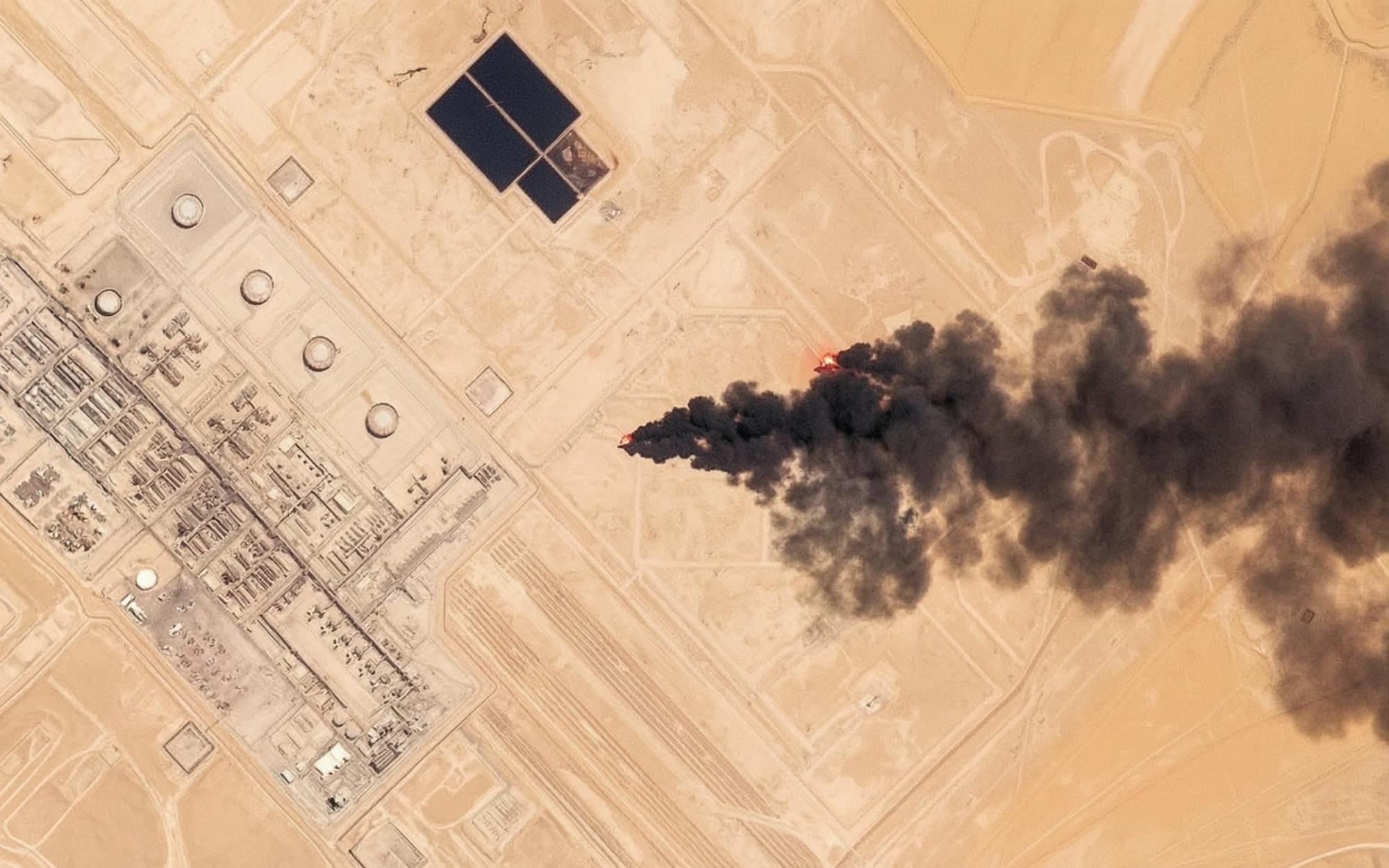
Reuters reported hearing two booms in Riyadh during the alerts. The news agency subsequently reported that a large plume of smoke and flames could be seen near King Khalid International Airport, the Saudi capital’s main airport.
The cause of the smoke and flames was not immediately clear. Saudi authorities did not immediately respond to CNBC’s request for comment, leaving the circumstances surrounding the reported activity near the airport unconfirmed.
The developments came as forces backed by Iran intensified attacks on Saudi Arabia in recent weeks. The Houthis in Yemen also launched a rapid ground offensive around the Bab el-Mandeb Strait, a strategically important choke point for oil shipments.
The Houthi offensive seized Mokha and nearby islands, according to the source report. The advances added pressure around a shipping passage that holds major importance for regional oil movements.
At the same time, U.S. President Donald Trump’s administration approved the potential sale of nearly 50 F-35 warplanes to Saudi Arabia. The proposed package is valued at $24.3 billion and was described as a major boost for the kingdom.
The package, announced Thursday, covers 48 advanced F-35 jets produced by Lockheed Martin. It also includes 49 Pratt & Whitney engines and other parts associated with the potential sale.
Pakistan’s Deputy Prime Minister and Foreign Minister Ishaq Dar spoke Saturday with Iranian Foreign Minister Abbas Araghchi. Their conversation occurred as regional diplomatic attempts to resolve the conflict between the United States and Iran remained stalled.
“DPM/FM stressed the importance of uninterrupted energy supplies and the safe and expeditious passage of ships, particularly given their implications for developing countries and global supply chains,” Pakistan’s foreign ministry said in a post on X.
Dar and Araghchi agreed to meet on the sidelines of the United Nations General Assembly in New York the following week. Pakistan’s foreign ministry disclosed the planned meeting after their Saturday discussion.
Reuters reported that a State Department spokesperson said on Sept. 11 that a “core delegation from the Iranian regime” would be permitted to attend the gathering. The spokesperson said the decision was consistent with United States obligations as host country for the world body.
Trump said Wednesday that the country was hopefully approaching the end of its nearly seven month war with Iran. The conflict has disrupted energy supplies moving through the Strait of Hormuz between Iran and Oman.
Brent crude, the international oil benchmark, has risen 72% since the beginning of 2026 as the war restricted those energy flows. The increase reflects the market pressure associated with diminished supplies through the strategically important waterway.
Saudi Arabia has sought to move oil exports away from the Strait of Hormuz by pumping crude through its East-West pipeline to the Red Sea. A drone attack that Saudi Arabia said originated in Iraq damaged that pipeline on Sept. 11 and forced its shutdown.
Despite the closure, crude prices declined for a third consecutive session Friday and ended the week essentially flat. The market anticipated that the East-West pipeline shutdown would have less impact on supplies than initially feared.
U.S. West Texas Intermediate futures dropped 1.6% and closed at $100.30 per barrel. Brent crude finished 0.9% lower at $103.87, even as the regional war continued to constrain energy supplies and complicate shipping routes.

Join the Discussion
COMMENTS POLICY: We have no tolerance for messages of violence, racism, vulgarity, obscenity or other such discourteous behavior. Thank you for contributing to a respectful and useful online dialogue.